Monday, July 7, 2014

Experts say dilbit could have caused Mayflower, Arkansas oil spill

From:  Tree Hugger

Chris Tackett (@ChrisTackett)

September 20, 2013


exxon pegasus pipeline cut photo

According to experts in the failure of oil and gas pipelines, there are a handful of factors that can contribute to a pipeline rupture, like the one on Exxon Mobil's Pegasus pipeline that spilled toxic diluted bitumen or dilbit from the Canadian tar sands into a Mayflower, Arkansas lake and subdivision.

Those factors include pressure swings within the pipe, reversing the direction of the flow of oil, the quality of the original pipe construction and a build-up of hydrogen atoms inside tiny cracks in the pipe.

Elizabeth Douglass reports at The Arkansas Times that all of these factors were in play in the Pegasus pipeline rupture.

Some operators may change their pumping pressures and their cycles to accommodate customers or to push more crude through the pipe faster, which generates more fees. Exxon, for example, increased the amount of dilbit flowing through the Pegasus by 50 percent in 2009. To accomplish that without installing larger pipe, Exxon had to send oil through the pipe faster, either by adding pumping stations or increasing the overall operating pressure, or a mix of the two.

Three years earlier, in 2006, Exxon also reversed the direction of the pipeline's flow, a move that would automatically alter the impact of pressure cycles by changing where the highest and lowest pressures hit along the pipeline.  MORE

Prairie Potholes, Glacial Till, and Why the XL Pipeline Should Never be Built


Compiled by Dwight Collins


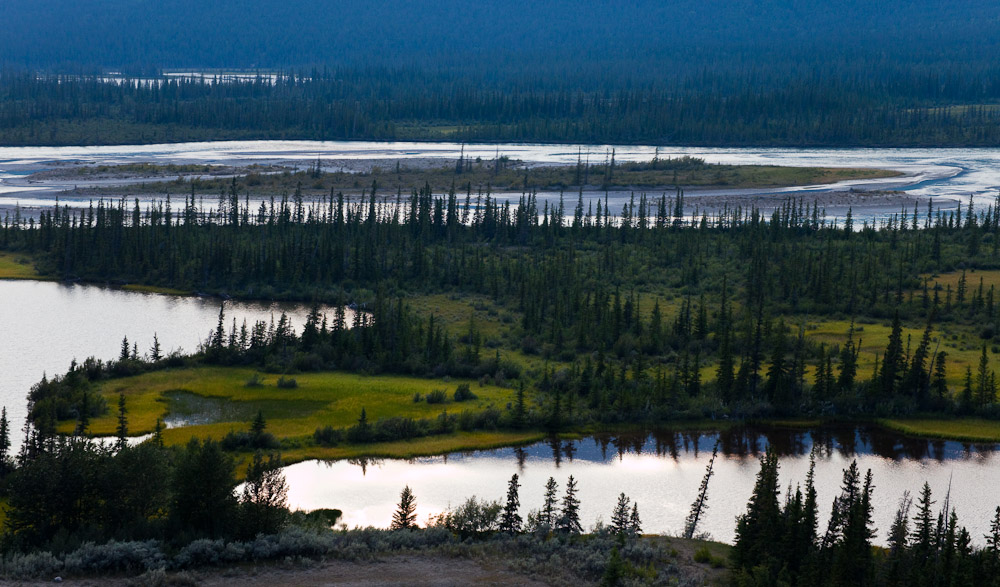
Boreal Forest Region: Alberta, Canada
  Mighty rivers drain north and east from the Rocky Mountains into the watershed of the Arctic Ocean


Look at any map of Alberta and you will see them: The Athabasca, Smoky, Peace, Chinchaga and Hay, tracing sinuous patterns across the vast northern half of the province, a lightly populated and little-known region of dark forests and muskegs.
This is the Boreal Forest Region which comprises 48 percent of Alberta.


The boreal forest is a critical ecosystem. The tar sands deposits lie in the boreal plains ecozone, which covers 183 million acres (74 million hectares) and extends across British Columbia, Northwest Territories, Alberta, Saskatchewan, and Manitoba. Forest cover is predominantly coniferous, and black spruce, white spruce, jack pine, and tamarack are principal species. Hardwoods, particularly trembling aspen, white birch, and balsam poplar, are well represented and are often mixed with conifers. This is one of the most productive forest areas not only in Canada, but in the entire world.

Approximately 35 percent of the boreal plains is composed of wetlands, including bogs, fens, swamps, marshes, and shallow open-water ponds. Some areas of the boreal plains have 85 to 95 percent wetland ground coverage, and these areas can stretch as wide as 120,000 acres (48,500 hectares). These extensive wetland and water areas combine with complex uplands to create a diverse mosaic of bird habitats. Most of these wetlands are connected through surface and groundwater hydrology and are highly susceptible to damage from tar sands development.  MORE

Saturday, July 5, 2014

Amazon Logging Town Struggles Amid Tough Crackdown on Deforestation


'Gold mining stopped, logging stopped, everything stopped. I don't have anybody to sell to.'

A team from the Brazilian Institute of Environment and Renewable Natural Resources (IBAMA), the government's environmental law enforcement agency, monitors property near Novo Progresso, Para, for illegal logging and other activity. Many residents there have yet to make their peace with the law to curtail deforestation, or the government seeking to enforce it. Credit: Jeff Tollefson, InsideClimate News

Jeff Tollefson is reporting from the Brazilian Amazon for eight weeks and exploring Brazil's efforts to protect the world's largest rainforestand the earth's climate. 
The situation was still a little tense when I arrived in Novo Progresso, Para, a frontier town that serves as the regional base for the federal government's environmental law enforcement agency, known as IBAMA. Two weeks earlier an IBAMA team had burned three large logging trucks and a tractor that were operating illegally outside a neighboring city; protesters rioted, briefly trapping agents in a hotel and later blocking one of the main highways into the Amazon. Everybody in Novo Progresso had an opinion on the matter, and many felt that a line had been crossed.

As an outsider, I could see many lines being crossed. I wondered why this one in particular triggered a revolt, or alternatively, why such tactics haven't triggered national controversy. After all, the nightly news was chock full of protests against government spending on soccer's World Cup rather than health, education, infrastructure and security for Brazilian citizens. A simplistic reading would suggest that the tradeoffs are the same when it comes to spending on trees, but I never saw anybody rioting in objection to government investments in forest conservation.

This tension drew me to Novo Progresso, a roadside town whose jurisdiction covers 25,000 people sprawled across an area larger than Maryland. My travels to the south in Mato Grosso had focused on regions where occupation of the land was more or less established, where the frontier had come and gone. Farther north, I had centered on areas that were turning a corner, where communities seemed to be buying into the government's battle against deforestation. By contrast, Novo Progresso is in a region where many residents have yet to make their peace with the law, or the government seeking to enforce it.  MORE

Study links Oklahoma earthquake swarm with fracking operations


On America's 238th birthday, it's time to examine our shrinking circle of liberty

From:  Natural News

by J. D. Hayes


liberty

(NaturalNews) Not long ago, a steadfast and determined group of British subjects banded together to form a political movement whose aim was to throw off the shackles of authoritarianism and form a nation built on divinely inspired and sanctioned principles of personal liberty and freedom. This would be a grand experiment; it would be the first time in recorded human history that a government was premised on the concept that the governed must consent, and that those who did the governing would come from the people themselves.

This experiment, of course, refers the founding of the United States; those early British subjects who laid their blood and treasures on the line to fight for independence from the whims of a monarch became the first American citizens.

It's appropriate, as we gather with our families and friends in observance of our nation's 238th birthday, to see how far we have come; in many respects, we have nearly come full circle.

In a relatively short time span, when you consider the earth's age, America has changed dramatically. The institutions of our founding are still in place, but in many respects they no longer function as they were designed or intended:

-- Presidents assume the function of king when they write executive orders that take on the appearance and force of law. Executive orders are only supposed to be tools of the Executive Branch in administering the bureaucracy, not rule-making apparatuses. That's Congress' job.

-- And speaking of Congress, there are several tools at its disposal to ensure that both the Executive and Judicial Branches don't overreach. One tool is the power of the purse, which has been used many times in the past; Congress -- especially the House -- can choose not to fund certain pieces of legislation or court jurisdictions or Executive Branch bureaucracies, which effectively render them moot. But Congress almost never does this anymore.

-- Speaking of the bureaucracies, there are so many federal agencies now (430 in total, as you can see here) -- and all under the president's control -- together they form a de facto fourth branch of government. These agencies impose costs of more than $1.8 trillion annually on U.S. businesses and industries (which means, on Americans, because those costs are transferred to consumers), a figure that is equal to the world's 10th largest economy.

These agencies regulate every aspect of our lives -- what we can plant and grow, what we can drive, what kind of light bulbs we have to use, how much flushing water our toilets can use, what we can and cannot do on our own land, what kind of weapons we can and cannot have, what kind of health insurance we have to purchase (and we have no choice but to do so) and so on.

-- The Judicial Branch has long been divided along political and ideological lines, which is not its original design; some are "conservative," and some are "liberal," but only a few of them are literal interpreters of the Constitution, their primary duty. Have you ever watched the confirmation process for a Supreme Court justice? Confirming all federal judges, from the lowest court to the highest, is a function of the Senate; over the decades, the process has devolved into a political witch hunt, because presidents over the decades have politicized the process (Franklin Roosevelt tried to pack the high court with liberals when, in 1935, a majority of justices began overturning major portions of the New Deal, ruling them unconstitutional).

In addition, the courts have also turned to legislating; the most recent example of this was when Chief Justice John Roberts rewrote Obamacare's individual mandate from a mandate to a tax, which even the President said was not the case.

The result of more than 230 years of gerrymandering with the Constitution's original intent has bastardized the founders' vision of individual freedom above all else, the result of which has been an ever-shrinking circle of liberty for all Americans. This July 4th is a good time to reflect on the state of our grand experiment and begin focusing on ways that We the People can reclaim what is rightfully ours: Our government.

Sources:

https://www.federalregister.gov

Thursday, July 3, 2014

July 3, 2014 – Declaring Revolution July 2, 1776


by Melinda Pillsbury-Foster

As the memory of fireworks fade the day after the 4th of July, remember the date for declaring Independence from England was actually July 2nd.. A final version of the Declaration took two more days. It was the 2nd which John Adams believed would become, “the most memorable epocha in the history of America.” He was wrong.

July 4th was the date Congress approved the finalized text of the Declaration produced by the five man committee assigned to give final form and substance to the ideas and causes which had compelled the Continental Congress to action. But not all agreed. One of the committee members, Robert Livingston, believed was a far too drastic step at that time and refused to sign.

Thomas Jefferson, who we remember as the Father of the Declaration, watched his final draft undergo 86 changes, shortening the overall length by more than a fourth. Many of these changes, including his inclusion of anti-slavery language, were made over his strong objections.

Jefferson had drawn on two primary sources for his own draft. The first a preamble to the Virginia Constitution and George Mason’s draft of Virginia’s Declaration of Rights. Jefferson's document is a restatement of John Locke’s contract theory of government, stating that governments derived “their just Powers from the consent of the people.”

On July 5th around 200 copies of the Declaration were typeset and printed in John Dunlap’s Philadelphia print shop. Copies were dispatched to various committees, assemblies, military commanders and foreign nations.

On July 6th the Pennsylvania Evening Post became the first newspaper to reprint the whole Declaration.

The first public reading of the Declaration occurred on July 8, 1776 in Philadelphia.

Getting the news out to the world, especially to King George and the rest of the colonies, proceeded as rapidly as possible. News of the Declaration reached London the second week of August via the Mercury packet ship.

The London Gazette, the official Crown organ, broke the news in its Saturday, August 10 edition.

The official ceremony of signing took place a month later, on August 2. But the text of the Declaration had already been published and republished in newspapers in a minimum of twenty-nine American newspapers and one magazine.

Jefferson later said he did not intend to say things that "had never been said before." But this is exactly what had transpired and because of these events the world changed.

Tuesday, July 1, 2014

Ohio Fracking Fire Likely Cause of Large Fish Kill

From:  EcoWatch 


Ohio Department of Natural Resources and state Environmental Protection Agency officials have launched an investigation to find out what killed a large, but unspecified, amount of fish in a creek that feeds into the Ohio River.
While Ohio officials are willing to concede that a fire at a nearby shale gas fracking site “likely” contaminated Monroe County’s Opossum Creek, according to the Columbus Dispatch, one environmental group appears more certain that those dots have a connection. An ODNR official confirmed the fish kill Sunday—just a day after the fire temporarily displaced about 25 area families.
Ohio officials initially said they did not know if a nearby fracking fire caused a fish kill, but that soon changed. Photo credit: Nathan Johnson / Ohio Environmental Council
“The fracking fire appears to have left a miles-long trail of death and destruction in its wake with thousands of dead fish and wildlife floating belly up in this once pristine stream,” Nathan Johnson, staff attorney for the Ohio Environmental Council. “This may be unprecedented, perhaps the biggest Ohio fish kill in memory related to the oil and gas industry.”  MORE